Retail
Retail Store Audit: Checklist, Process & Best Practices
Learn how to conduct a retail store audit, check planogram and merchandising execution, prioritize findings, and turn store gaps into corrective action.

CEO - Pazo

Learn how to conduct a retail store audit, check planogram and merchandising execution, prioritize findings, and turn store gaps into corrective action.
A retail store audit compares what is actually happening inside a store with the standards the retailer expects—covering product availability, planogram execution, visual merchandising, pricing, promotions, operations, and compliance.
A useful audit does more than produce a score. It should identify the execution gap, capture evidence, assign corrective action, and verify that the problem was fixed.
A retail audit becomes much more valuable when it closes this loop rather than ending when the checklist is submitted.
A retail store audit is a structured assessment of whether a store is executing the standards defined by the retailer, brand, or operating team.
The simplest way to understand an audit is:
Expected state → Actual state → Gap
For example, a beverage planogram may require SKU A to occupy three facings in positions 2–4 on a particular shelf.
During the audit, the product may be present but have only two facings and be positioned elsewhere.
The product is available, but the shelf is not compliant with the merchandising standard.
That distinction matters.
A store audit can evaluate several parts of execution at the same time:
It is therefore broader than simply walking around a store and looking for problems.
The purpose is to create a consistent way of answering:
What should be happening? What is actually happening? Where is the gap? What needs to happen next?
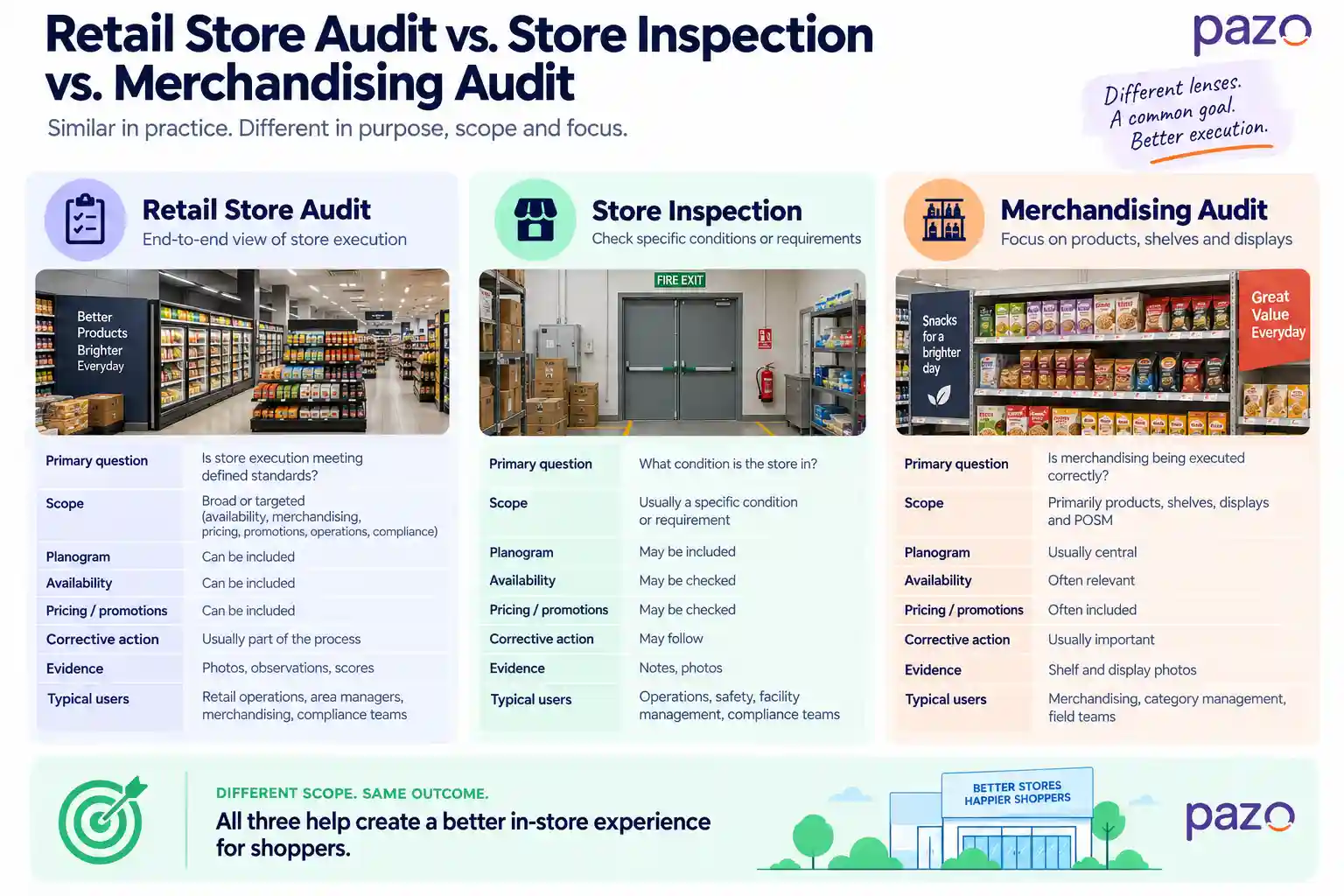
A store inspection typically asks:
“What condition is the store in?”
A merchandising audit asks:
“Is merchandising being executed according to the defined standard?”
A retail store audit asks:
“Is the store executing the required standards, where are the gaps, and what needs to be corrected?”
There can be overlap. A retailer might include safety checks in a broader store audit or include availability checks in a merchandising audit.
The terminology matters less than defining the business purpose and expected outcome before creating the checklist.
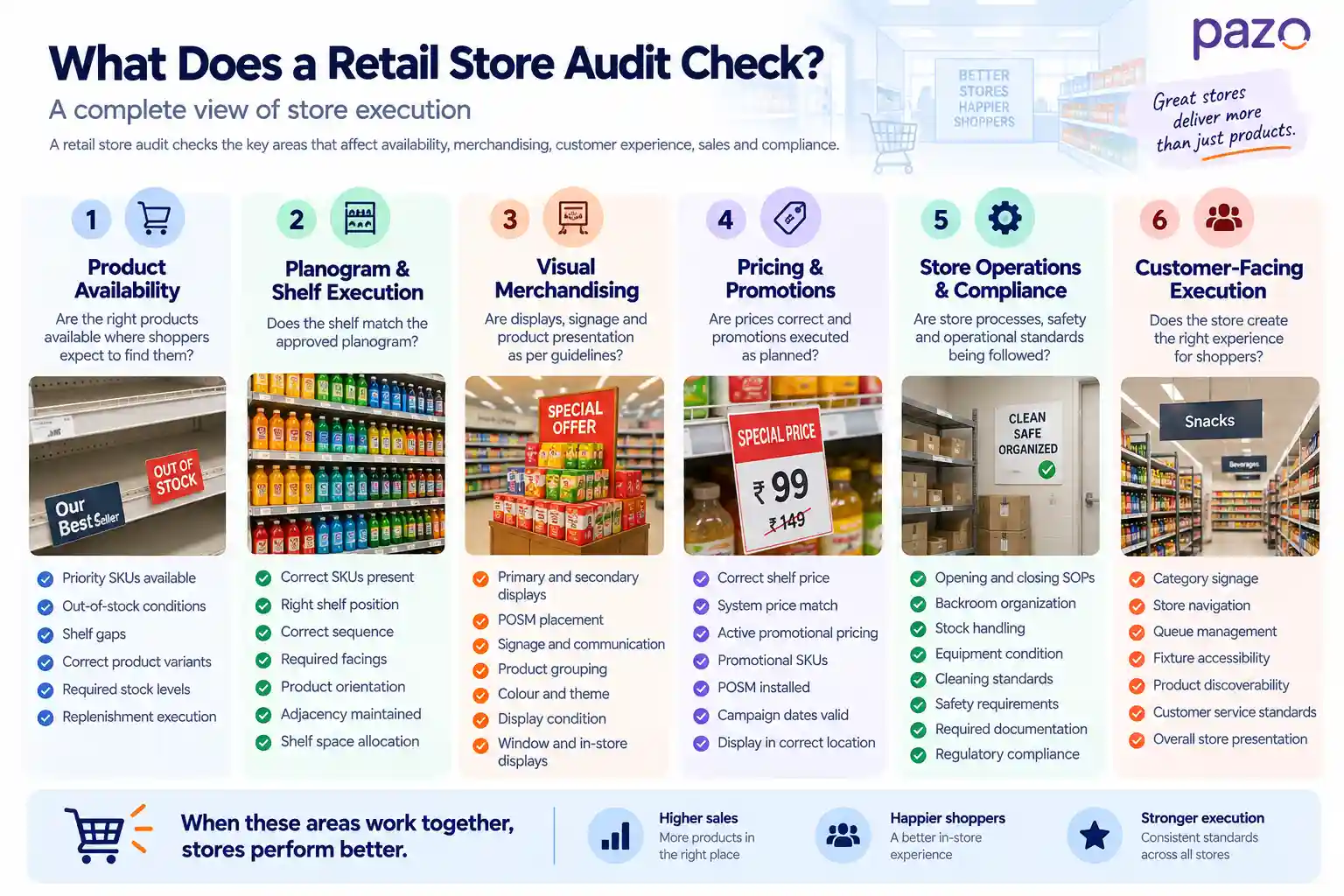
A useful retail store audit checks the areas that influence store execution rather than trying to document every possible condition in the building.
Six areas commonly matter.
The first question is straightforward:
Are the products shoppers are expected to find actually available?
An availability audit can check:
But a shelf gap is only an observation, not necessarily a diagnosis.
An empty shelf could mean the product is out of stock. It could also mean stock is sitting in the backroom, replenishment was missed, the product was placed somewhere else, or the shelf allocation is incorrect.
The audit should therefore capture enough context to determine what action is required.
A product being present does not mean the shelf is correctly executed.
For planogram compliance, the audit should look beyond simple SKU presence.
A practical merchandising sequence is:
SKU → Position → Sequence → Facing → Orientation → Adjacency → Allocation
For example:
This catches a common audit mistake: treating “product present” as equivalent to “planogram compliant.”
It isn't.
Visual merchandising checks whether the store's physical presentation matches the intended merchandising standard.
Depending on the format, this may include:
A display can look attractive and still be commercially wrong.
For example, a promotional display may be visually neat but positioned in the wrong zone, contain the wrong products, or lack the required communication.
The audit therefore needs to evaluate execution against a defined standard, not simply whether something looks good.
Pricing errors are particularly useful to audit because they can directly affect both customer trust and store execution.
Checks may include:
One important distinction is:
POSM presence does not prove that a promotion has been correctly executed.
The right POSM may be installed while the wrong SKU is promoted, the price is incorrect, the campaign has expired, or the display is in the wrong location.
A good audit checks the complete promotional requirement rather than treating the presence of signage as proof of compliance.
A store audit can also evaluate whether operational standards are being followed.
Depending on the retailer, this may include:
The important point is to convert each requirement into something that can actually be observed.
Instead of:
“Is the store compliant?”
ask:
“Is the emergency exit unobstructed?”
Instead of:
“Is stock handled correctly?”
ask:
“Are returned products stored in the designated area?”
The second version gives the auditor something specific to inspect and gives the store team something specific to correct.
Some audit questions should focus on what the shopper actually experiences.
These may include:
The goal isn't to turn every subjective shopper experience into a score.
The goal is to identify observable execution issues that can affect the customer journey.
The strongest audit questions are:
Specific → Observable → Measurable → Actionable
A strong audit is not simply a checklist that an employee completes.
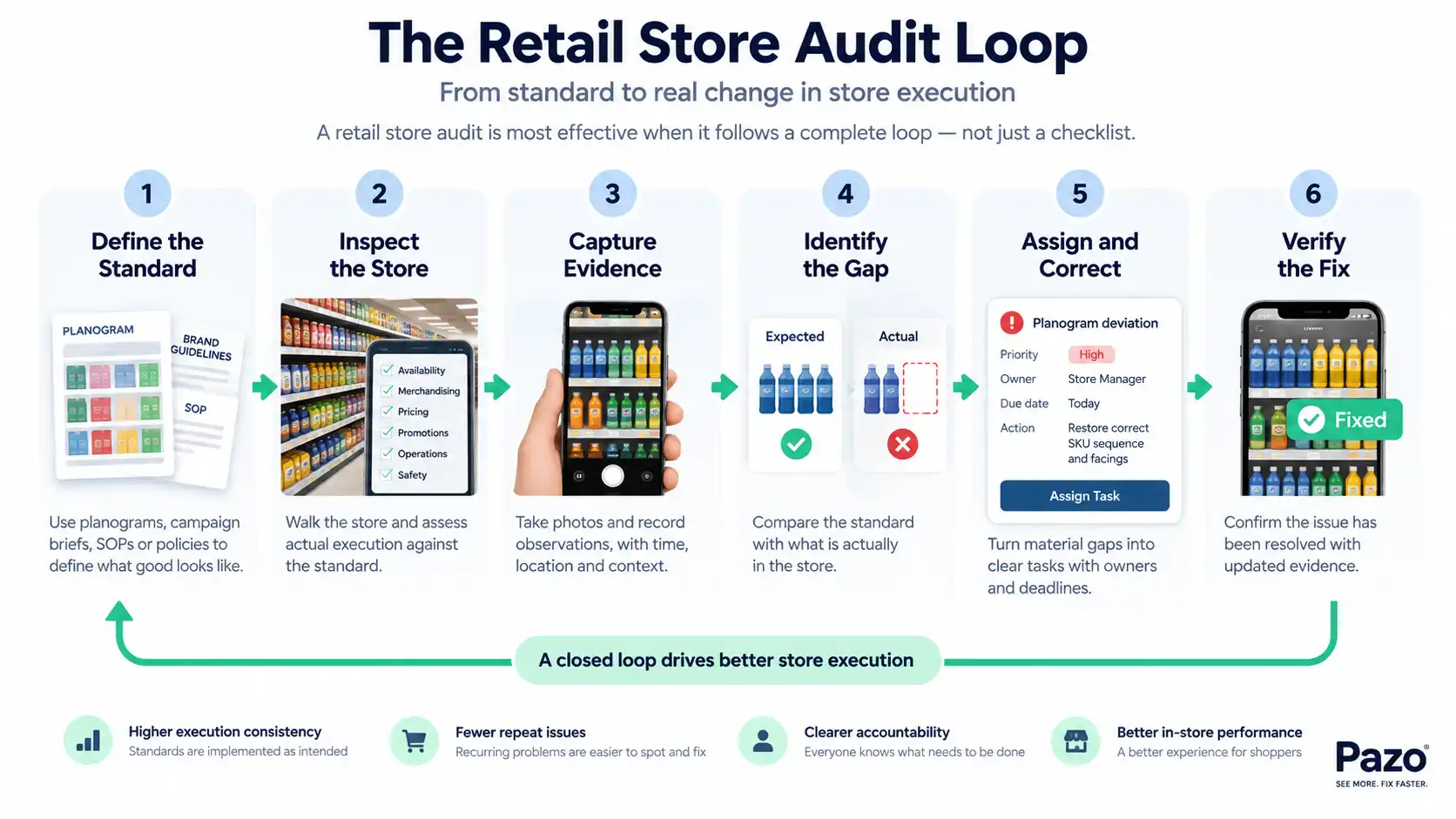
It is a closed operational loop:
Standard → Inspect → Evidence → Gap → Correction → Verification
Here is how that works in practice.
Start with the decision the audit needs to support.
Are you trying to measure:
The purpose determines what should be measured.
A common mistake is starting with a long list of questions and only later deciding what the audit is supposed to accomplish.
The better sequence is:
Business objective → Standard → Audit questions → Evidence → Action
Standards such as “maintain good merchandising” are too broad to audit consistently.
Break them into observable requirements.
For example:
Broad requirement:
Maintain the approved beverage planogram.
Auditable requirements:
This makes scoring more consistent and makes corrective action much easier.
Not every question needs a photograph.
Evidence should be selected based on the risk and importance of the requirement.
A photo may be useful for:
Other checks may only require a yes/no response or a numeric value.
The important thing is that evidence should help someone understand and act on the finding later.
A useful evidence record may contain:
Photo + Location + Standard + Observation + Priority + Owner + Due Date
This creates much more value than a photo sitting by itself in a report.
The auditor then compares the actual store against the defined requirement.
This is where discipline matters.
The auditor should not silently change the standard based on what seems reasonable at the time.
If the planogram says three facings, the audit should record the actual number.
If the promotional brief specifies a particular location, the audit should check that location.
If the requirement has changed, the standard should be updated before the audit rather than informally changed during the inspection.
This is one of the most useful distinctions in store auditing.
Suppose an auditor sees an empty shelf.
The observation is:
“SKU A is not present on the shelf.”
The diagnosis might be:
“SKU A is out of stock.”
But the diagnosis isn't necessarily proven.
There could be stock in the backroom.
The product might have been moved to another location.
The replenishment process might have failed.
The product might have been incorrectly substituted.
So the audit should distinguish between:
What was observed and why it happened.
Technology can help identify the first. The second may require operational context.
Not every observation should automatically become a task.
A minor cosmetic issue may not need the same workflow as a priority SKU being out of stock or a major promotional failure.
For material findings, the action should specify:
For example:
Finding: SKU C has two facings instead of three and is positioned after SKU B.
Owner: Store Manager
Priority: High
Action: Reposition SKU C according to the approved planogram and restore three facings.
Verification: Updated shelf photo.
This turns an audit observation into something operationally useful.
An audit is not operationally complete when the checklist is submitted.
It is complete when material findings have been:
Assigned → Corrected → Verified
Verification can involve:
The purpose is to avoid confusing reported with resolved.
A finding marked “closed” without evidence may simply mean that someone changed its status.
Verification provides confidence that the physical execution actually changed.
Individual findings are useful.
Patterns are more valuable.
Suppose 50 stores repeatedly fail the same planogram requirement.
The answer may not be to send the same corrective instruction to 50 stores.
The repeated failure could indicate:
This changes the role of the audit.
The audit is no longer only measuring stores.
It is helping the organization understand why execution repeatedly breaks down.
A checklist should contain questions that can be answered consistently by different auditors.
A practical structure could look like this:
The quality of the questions matters more than the length of the checklist.
Compare:
“Is merchandising correct?”
with:
“Are SKU A, B and C in the approved sequence?”
The second question has a much lower interpretation gap.
A retailer does not necessarily need photographs for every checklist item.
Too much evidence creates unnecessary audit workload and can make reporting difficult to manage.
Use evidence where visual or contextual proof matters most.
A supermarket, convenience store, department store and specialty retailer may not require identical questions.
However, the measurement logic should remain consistent wherever possible.
For example, the concept of planogram compliance can remain consistent even when the exact shelf standards differ by format.
This allows retailers to compare execution without forcing every store into an identical checklist.
A good test for every checklist question is:
If this answer is “No,” does someone know what they need to do next?
If not, the question may be too vague.
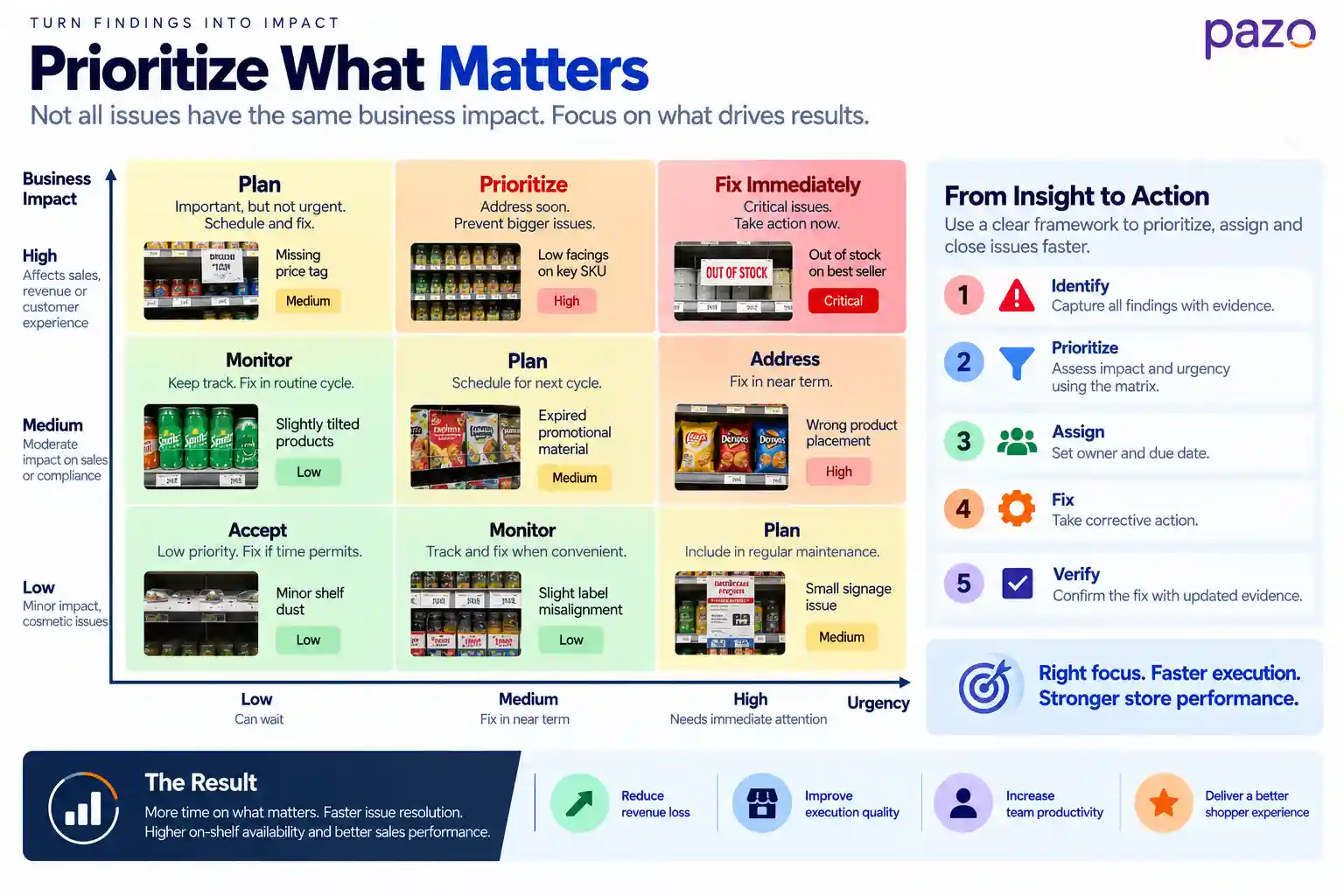
Not every audit finding deserves the same response.
A useful practical model is:
Impact × Severity × Urgency
This is a decision framework rather than a universal retail-industry scoring standard.
For example:
The finding lifecycle should be clear:
Observation → Finding → Priority → Owner → Deadline → Correction → Verification
A useful finding record might therefore contain:
The objective isn't to create tasks for every small observation.
It is to ensure that important execution gaps do not disappear inside an audit report.
When the same finding appears repeatedly across stores, the organization should also investigate the underlying process rather than continuously assigning the same correction.
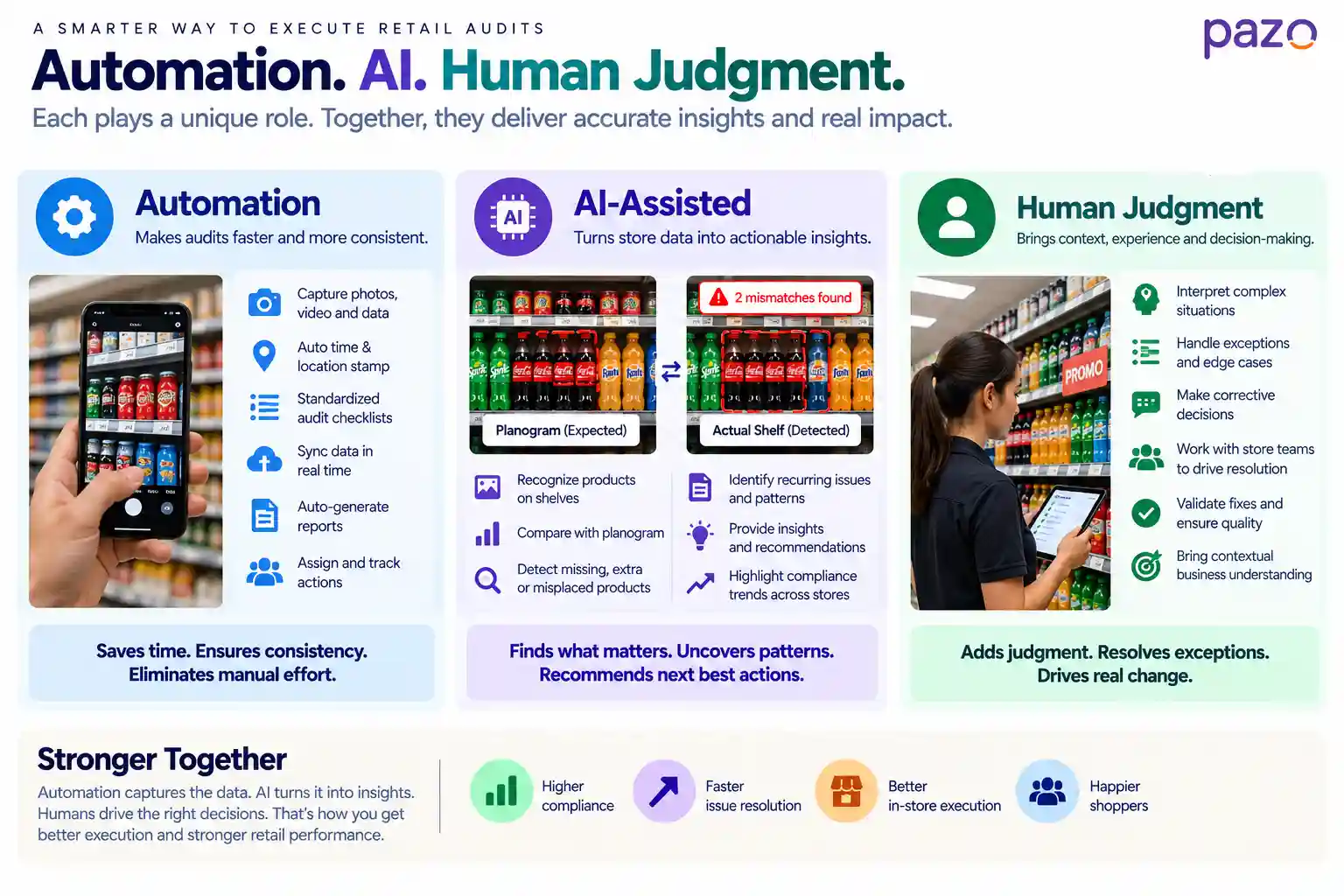
Technology can remove a large amount of manual administration from retail audits, but it should not be treated as a replacement for operational judgment.
Automation is useful for repetitive administration:
AI and computer vision can assist with repetitive visual analysis.
Potential applications include:
But detection is not the same as diagnosis.
An AI system may identify an empty shelf.
It may not know whether the cause is an inventory problem, replenishment failure, backroom stock, a planogram issue or an operational exception.
That distinction matters when designing an AI-enabled audit process.
The practical approach is:
Automate capture and administration. Assist with repetitive visual analysis. Keep important operational decisions with the people who understand the context.
Retail audit software becomes useful when the execution loop is difficult to manage through spreadsheets, paper checklists, email or messaging applications.
The need usually becomes apparent when retailers struggle to:
Platforms such as Pazo can centralize digital audits, evidence capture, reporting, corrective-action tracking and store-execution analytics in one workflow.
The important consideration is not how many software features a retailer can deploy.
It is whether the technology makes it easier to move from:
“We found a problem.”
to:
“We know what the problem is, who owns it, whether it was fixed, and whether it keeps happening.”
A useful retail store audit answers four questions clearly:
The checklist is only the starting point.
The real value comes from closing the loop between standard, observation, evidence, action and verification.
Technology can make that loop faster and easier to manage. AI can help identify patterns and repetitive visual deviations. But the quality of the audit still depends on clear standards, useful questions and sound operational judgment.
The goal is not to produce more audit data. It is to make store execution more consistent—and make recurring problems easier to see, fix and prevent.
As someone who has built highly scalable products from the ground up, I've always been drawn to solving challenging problems. But it's the quest for operational excellence that truly lights my fire. The thrill of streamlining processes, optimizing efficiency, and bringing out the best in a business – that's what gets me out of bed in the morning. Whether I'm knee-deep in programming or strategizing solutions, my focus is on creating a ripple effect of excellence that transforms not just businesses, but the industry at large. Ready to join forces and raise the bar for operational excellence? Let's connect and make retail operations and Facilities Management better, together.
Stay up to date with the latest video business news, strategies, and insights sent straight to your inbox!